


Published at: Jul 11,2026
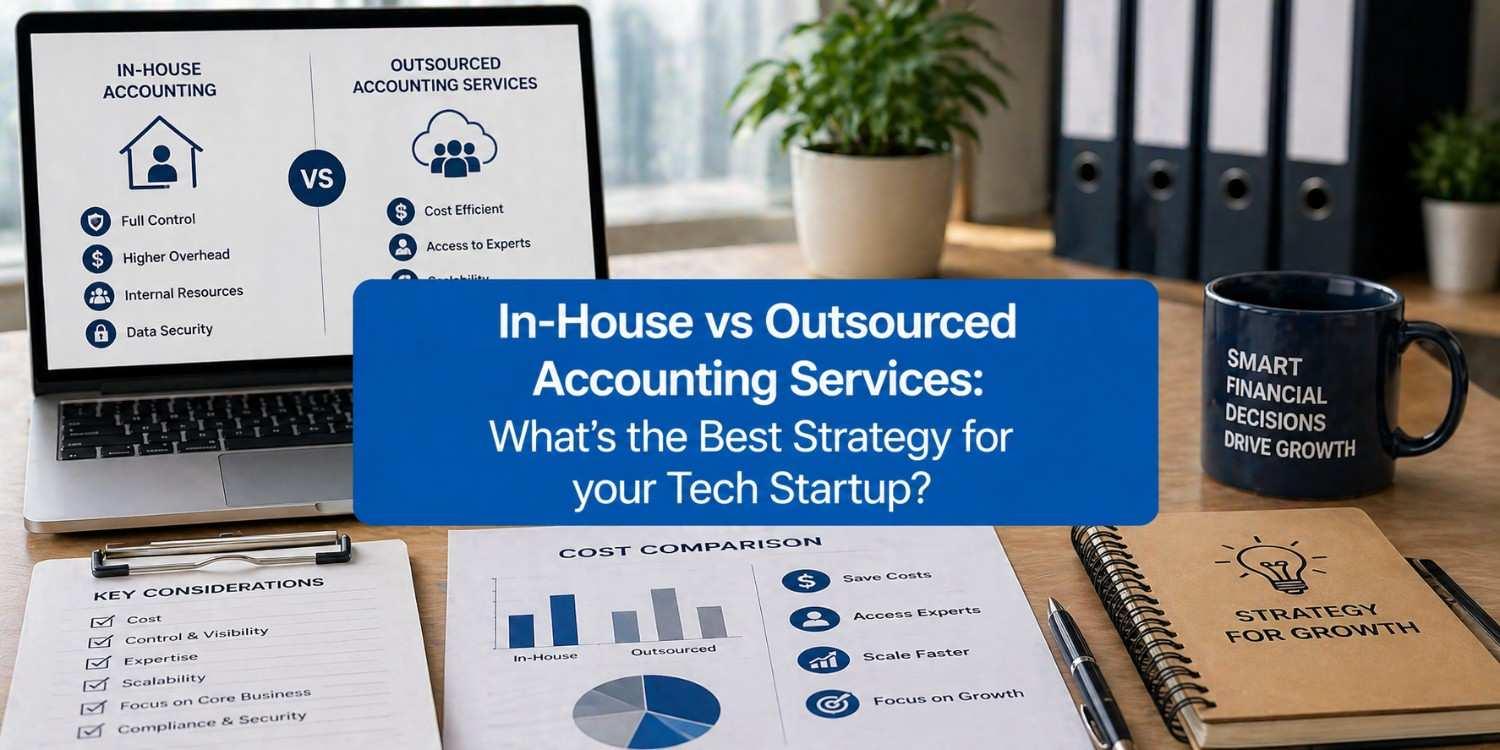
If you are building a tech startup, your finance setup can either support growth or quietly slow it down.
Many founders start with spreadsheets, ad-hoc bookkeeping, and year-end compliance support. But as transactions increase, payroll expands, investors ask harder questions, and cash runway becomes tighter, one decision becomes unavoidable: should you build an in-house accounting team or outsource accounting to specialists?
The short answer: most early-stage and growth-stage tech startups benefit more from outsourced accounting because it gives them faster access to expertise, stronger compliance, cleaner reporting, and lower fixed overhead. In-house finance usually makes more sense when transaction volume is very high, finance processes are deeply embedded across departments, or the business needs daily on-floor financial operations.
In this guide, we break down both models in practical terms so you can choose the right approach for your current stage, budget, and growth goals.
If you want a stronger finance foundation before making that decision, start with this accounting guide for startups.
In-house accounting means you hire internal employees to manage bookkeeping, reconciliations, reporting, payroll coordination, tax support, and finance operations.
Outsourced accounting means you work with an external finance partner that handles some or all of those functions for a monthly fee or service package.
For many startups, outsourced support can include not just bookkeeping, but also compliance, management reports, cash flow visibility, fundraising prep, and Virtual CFO services.
Factor | In-House Accounting | Outsourced Accounting |
Cost structure | Higher fixed monthly cost due to salaries, hiring, training, tools, and overhead | Lower and more flexible monthly cost based on scope and business stage |
Access to expertise | Depends on the person or small team you hire | Access to broader specialists across bookkeeping, compliance, reporting, tax, and strategic finance |
Scalability | Slower to scale; requires new hiring as complexity grows | Easier to scale services up as transactions, reporting, and compliance needs increase |
Control and proximity | High day-to-day internal access | Strong process control, but less physical proximity |
Compliance discipline | Varies by team experience | Usually stronger because specialist teams work across recurring compliance cycles |
Investor readiness | Can be strong if you hire experienced finance talent | Often stronger at early stages because startups get structured reporting sooner |
Hiring dependency | High; performance depends on recruitment and retention | Lower; service continuity is not dependent on one employee |
Best fit | Larger startups with complex internal finance workflows | Early-stage and growth-stage startups that need quality finance support without full-time CFO cost |
Tech founders are expected to move fast, conserve cash, and stay investor-ready. That combination is exactly why outsourced accounting has become the preferred model for many startups.
Hiring an internal finance team is rarely just one salary. You also take on recruitment time, onboarding, leave coverage, software access, training, and the risk of hiring too junior or too late.
Outsourcing gives you access to structured bookkeeping support, reporting, and process discipline without locking yourself into a high fixed cost base too early.
That matters when your priorities already include product, hiring, customer acquisition, and runway management.
Startups often need more than transaction posting. They need clean books, monthly closes, statutory discipline, MIS visibility, founder dashboards, and answers to questions like:
How much runway do we really have?
Are our margins improving or shrinking?
What is the actual impact of delayed collections?
Are we prepared for diligence or fundraising scrutiny?
An outsourced partner can usually support these needs earlier than a single in-house hire can, especially when bundled with accounting and compliance services.
As your startup grows, missing a filing, misclassifying an expense, or delaying reconciliations becomes more expensive. Compliance issues do not just create penalties—they reduce management confidence and complicate due diligence.
Specialist finance teams work in recurring cycles, which helps keep books cleaner and deadlines tighter. That is especially valuable for startups handling vendor payments, payroll, GST, board reporting, and multiple revenue streams.
Founders need timely numbers to make timely decisions. Investors need credible numbers to trust the business. Outsourced accounting can improve both.
With the right partner, monthly reporting becomes more consistent, cash visibility improves, and the startup can produce cleaner financial packs for lenders, angels, VCs, or board members.
A startup’s finance needs rarely stay static. What works at 10 transactions a month breaks at 500. What feels manageable before fundraising becomes risky after a round.
Outsourced finance support is easier to expand in phases—monthly books first, then compliance, then dashboards, then forecasting, then strategic finance support.
If you want a predictable structure, a monthly accounting plan is often a better starting point than building a full team too early.
Outsourcing is not automatically the best fit for every startup. In-house accounting can be the better model when:
Your transaction volume is high enough to justify full-time internal staff
You need daily coordination between finance, operations, procurement, and leadership
Your business has highly customized workflows that require deep internal process ownership
You already have a capable finance leader who can build and supervise the team
You want finance embedded physically and operationally inside the company every day
Even then, many businesses still use a hybrid model: internal execution with external review, compliance, or strategic CFO support.
If your startup looks like this… | The better fit is usually… |
Pre-seed or early-stage, lean team, cost-sensitive, needs clean books and compliance | Outsourced accounting |
Growing fast, preparing for fundraising, needs management reporting and finance discipline | Outsourced accounting + Virtual CFO |
Large transaction volume, frequent internal coordination, mature finance operations | In-house accounting |
Has internal accounts staff but lacks strategy, controls, or investor-grade reporting | Hybrid model |
How complex are our books today—and how complex will they be in the next 12 months?
Do we need transaction support only, or also reporting, forecasting, and strategic finance input?
Can we justify a full-time finance hire right now?
How costly would compliance errors or reporting delays be for us?
Are we likely to raise capital, apply for debt, or enter diligence soon?
Do we need daily on-site finance involvement, or strong process-based support?
Are we solving for control, expertise, speed, or cost efficiency?
[!NOTE] Founder Checklist: If you are evaluating your current setup, use a simple founder checklist covering bookkeeping hygiene, compliance readiness, cash flow visibility, and investor-readiness markers before you decide between in-house and outsourced finance support.
Hiring too late: founders wait until finance chaos is already affecting decisions.
Hiring too junior: one low-cost hire may not be enough for reporting, controls, and compliance.
Confusing bookkeeping with finance leadership: accurate entries are important, but they are not the same as financial clarity.
Optimizing only for salary cost: the real cost includes rework, missed compliance, founder time, and poor reporting quality.
Ignoring fundraising readiness: messy books become painful when diligence starts.
Need help assessing your current finance setup? Book a founder-focused review and see whether your startup needs outsourced accounting, a hybrid model, or CFO-level support. Book a meeting.
Startup stage | Typical finance need | Recommended model |
Idea to pre-revenue | Basic setup, bookkeeping hygiene, compliance basics | Outsourced |
Early revenue | Monthly close, founder reporting, tax and compliance discipline | Outsourced |
Scaling | Better MIS, runway visibility, process maturity, lender or investor readiness | Outsourced + Virtual CFO |
Mature operations | Cross-functional finance operations, internal controls, dedicated teams | In-house or hybrid |
For most tech startups, outsourced accounting is the smarter starting point. It improves financial discipline without the cost and complexity of building an internal team too early. You get cleaner books, stronger compliance, more reliable reporting, and easier access to finance expertise as the business grows.
In-house accounting becomes more attractive when finance operations are large, constant, and deeply embedded inside the company. Until then, outsourced support is often the more practical, scalable, and founder-friendly option.
If your startup needs cleaner books, better reporting, and stronger financial visibility, EaseUp can help with outsourced accounting, compliance, bookkeeping, and Virtual CFO support tailored for growth-stage businesses.
Talk to EaseUp today: explore our Virtual CFO services, review our monthly accounting solutions, or contact us for a tailored recommendation.
For most early-stage and growth-stage startups, outsourced accounting is usually the better choice because it gives access to broader expertise, stronger process discipline, and a lower fixed cost base. In-house hiring becomes more practical when the startup has high transaction volume, mature internal processes, and a clear need for daily finance involvement.
A startup should usually add Virtual CFO support when founders need more than clean books—such as cash flow forecasting, runway planning, board reporting, fundraising preparation, margin analysis, or better financial decision-making. This often happens once revenue grows, investor conversations begin, or financial complexity increases.
Yes. A strong outsourced finance partner can improve diligence readiness by keeping books updated, reconciling balances on time, preparing cleaner monthly reports, and organizing the financial information investors typically review. That reduces friction when fundraising or debt discussions start.
The biggest risks are hiring too junior, relying on one person for everything, delayed reconciliations, inconsistent reporting, and weak compliance follow-through. For fast-moving startups, those gaps often lead to poor visibility, founder confusion, and costly clean-up work later.
Yes. Many startups use a hybrid setup where routine finance execution stays internal while compliance, reporting review, or strategic finance support is handled externally. This model works well when the company wants internal control but still needs specialist expertise and senior-level guidance.

October 27, 2026

Copyright © 2025 Easeupnow. All rights reserved.